The Martians
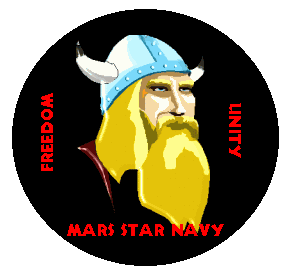
(Extracted from 'Mars Attacks!', T. Burton's classic study of the Martian Star Navy).
To examine the Martian character we must begin with the grand terraforming projects of the early 3rd milennium, as humanity began its first great leap into new colonies. Most of the engineers came from Old Mars, the very first terraforming project, begun by the so-called Helix Brotherhood (but later expanded to include other slightly more sane groupings). Accordingly, Martians were most prominent among the new worlds, where the pioneering frontier spirit of the early colonies bred a rugged individualism, and a dislike of authority, especially that represented by the growing Solar Republic and its Empire. In the inevitable conflict that followed, Martians were looked to by the colonies as the most technically able, and led the break from the stifling confines of Earth.
The original Martian Association of Free Colonies (MAFC) was a very loose affair, and the glue that held it together was the only major organisation held in common - the Martian Star Navy (MSN), where loyalty to the organisation and the principle of freedom came above loyalty to any individual world. Although blessed with hardy, practical colonists as its intake, the MSN had the difficult job of instilling discipline and cohesion into the individualist culture of the MAFC, and did so by adopting a warrior ethic and code self-consciously drawn from medieval Terran societies (esp Japan, Scandinavia). In this way the Martians laid the foundations of one of 32nd century humanity's most respected fighting forces - practical, can-do colonists drawn from inhosptable worlds that bred toughness and self-reliance, and trained to obey. As Terran Admiral of the Black G. Taylor put it during the Martian War of Liberation: "Earth trains soldiers, but Mars breeds warriors".
It has often been said, with good reason, that Martians "don't know when they are beaten". This has had both its good and bad points: the history of the MSN has its share of futile last stands and suicidal charges, but also incredible victories against impossible odds. The prowess of the Martian Navy has often compensated for the MAFC's past lack of coordination and direction.
Nevertheless, while the MSN was forbidden by its own codes from playing an overt political role, its warrior tradition bred a belligerence which fed back into the MAFC itself. When your best tool is a hammer, as the saying goes, most problems can come to look like nails.
But within only a few decades of its foundation, the Association of Free Colonies' greatest setback came with the Asteel Secession, which took with it the most dynamic and freewheeling part of the Association, and which has since expanded into one of the largest political groupings in space. While retaining traditional Martian virtues such as love of democracy and individualism, the Esteelers have concentrated their Martian aggression into a pursuit of the profit motive, and have never been able to turn their commerical success into the military success of Mars.
Since that catastrophe there has been a recognition by the MAFC that Martian individualism and lack of coordination contains the seeds of its own destruction, and has hampered the MAFC's development as a political force, and there has been a greater degree of centralisation among the Association's core worlds in Sector 0 (some of which now call themselves the Martian Union).
However, in this sense the new colonies have been an outlet for the core worlds' more individualistic and freebooting elements, and on the fringes the structure is much looser and more federal, with considerable leeway granted to indiviual worlds and to the Regional Councils that govern them. But the backbone of the MAFC was and remains the Martian Star Navy. Forbidden by its almost quasi-religeous code from ever playing an overt political role, it nevertheless remains the focus and unifying force of the Association, and the driving force behind Mars' aggressive pursuit of new colonies.
Postscript
The Exterminator threat has forced Mars to confront the reality that they cannot fight alone and still hope to win. Although the Battle of Flypaper regained Martian honour, badly dented at Baldar, it was as part of an alliance, under the command of Earth - the Old (but thereby respected) Enemy. Whether the crisis of confidence brought on by the Exterminators will bring about a softening of Mars' traditional belligerence, or whether humanity will need to harness every ounce of Martian aggression to survive, is not yet known.